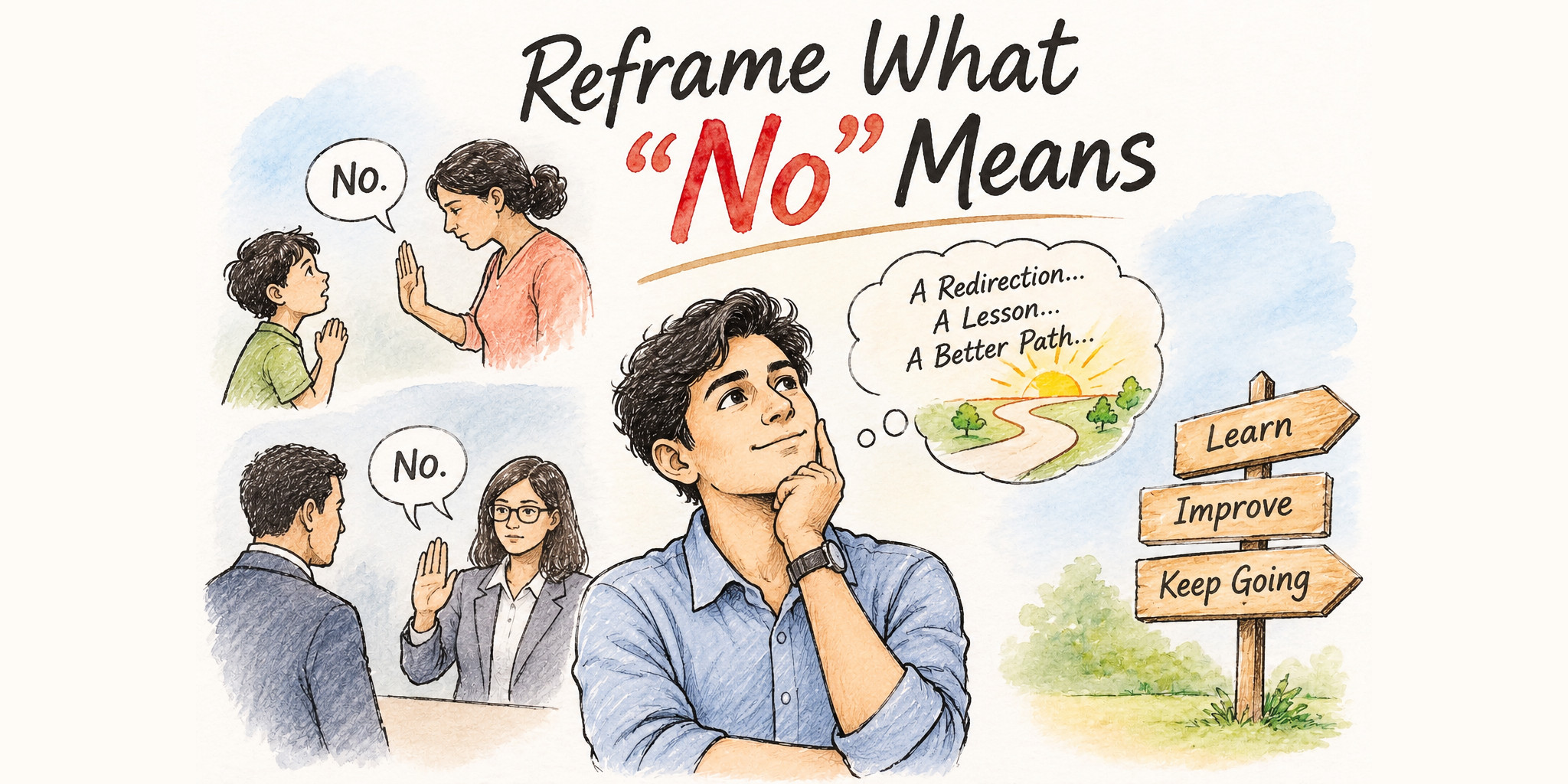
The First Time You Heard No
Think about a child who wants something. Perhaps a new toy. An extra hour of screen time. Permission to go out with friends. Something that, in the child's mind, is extremely important.
The child approaches a parent and makes the request.
"NO"
The conversation should be over.
But often, it isn't.
The child tries to understand the answer. Perhaps the timing was wrong. Perhaps the parents were busy. Perhaps the request was too expensive, the explanation was unconvincing, or the parent simply wasn't ready to agree.
A little later, the child returns.
“Please?”
“No.”
The child might offer a compromise. They might promise to finish their homework, complete a chore, or wait until the weekend. They might explain why the request matters so much.
Sometimes, after several conversations, the answer changes.
The child gets what they wanted.
Of course, not every child wins every argument. Some requests are refused permanently, and some parents are remarkably consistent. But the pattern is familiar: children often continue asking for things even after they have been told no.
Now imagine an adult doing the same thing.
An employee asks for a promotion and is turned down. A founder approaches a potential customer and receives a rejection. A writer submits an article that is declined. An entrepreneur presents an idea to a potential partner and hears that they are not interested.
What happens next?
Often, the conversation ends—not because every possibility has been explored, but because the word no has become too uncomfortable to hear again.
The child and the adult are not necessarily different in their desire to succeed.
They may simply have learned different relationships with rejection.
Somewhere along the way, many of us begin to treat a refusal as a reason to stop trying.
And that is where we lose opportunities.
What Does a No Actually Mean?
Imagine you have spent weeks developing a product.
You have thought about the problem, worked on the solution, invested your time, and perhaps spent money you could not easily afford to lose.
Finally, you show it to a potential customer.
You explain how it works. You describe the benefits. You answer questions.
The customer listens and says, “No, thank you.”
What happened?
Your mind may immediately begin producing explanations.
Perhaps the product isn't good enough.
Perhaps you aren't good at selling.
Perhaps the customer doesn't respect your work.
Perhaps you should have said something differently.
You replay the conversation. You remember the customer's expression. You search for the sentence that might have changed the outcome.
A simple refusal becomes a complicated judgment about yourself.
But stop for a moment.
What do you actually know?
You know that this person declined this offer at this point in time.
That is the fact.
Everything else is an interpretation.
The customer might not have the budget. They might already be using another product. They might not consider the problem urgent. They might not understand the benefits. They might be interested but unable to make the decision themselves.
Or perhaps they simply do not want what you are offering.
You don't know which explanation is correct until you learn more.
And that distinction matters.
no is an outcome. The meaning you attach to it is a separate decision.When we treat rejection as a verdict on our identity, we stop examining the situation objectively. When we treat it as information, we can begin asking better questions.
What did this conversation reveal?
Was the person the right audience? Was the problem important to them? Did they understand the offer? Was the timing appropriate? Is there something worth improving?
The objective is not to invent an excuse for every rejection.
It is to understand what happened without automatically concluding that something is wrong with us.
The Lesson From Go for No!
In Go for No! Yes Is the Destination, No Is How You Get There, Richard Fenton and Andrea Waltz challenge a familiar idea about success.
Many of us measure progress by the number of times we hear yes.
We want more customers, more approvals, more opportunities, more agreements. We try to minimize the possibility of rejection because rejection feels like failure.
But if we avoid our primary objective, we may also avoid the very conversations that could lead to success.
Consider a salesperson who contacts only people they are almost certain will agree to a meeting.
They may enjoy a high proportion of positive responses, but they might be missing many valuable opportunities.
Now consider someone willing to approach a broader range of appropriate prospects, knowing that some will decline.
They may hear no more often. They may also discover customers, partnerships, and opportunities that the first salesperson never encountered.
This is the central challenge: if you are unwilling to experience rejection, you may limit how much success you allow yourself to pursue.
The book invites us to reconsider the role of no.
Instead of treating it as the opposite of success, we can recognize that rejection is often part of the journey toward it.
You cannot guarantee that an attempt will succeed.
You can decide whether you are willing to make the attempt.What If We Changed the Goal?
Imagine two people approaching the same business opportunity.
The first person thinks:
I must convince this customer to say yes.
The second thinks:
I must have a meaningful conversation with this customer and discover whether there is a genuine fit.
The first person enters the conversation carrying a burden. Every objection feels dangerous. Every hesitation feels like a setback. They may talk too much, defend their offer too quickly, or become uncomfortable when the customer asks difficult questions.
The second person has a different objective.
They want to understand the customer's situation. They want to explain what they can offer. They want to discover whether the offer makes sense.
If the customer says yes, excellent.
If the customer says no, the conversation can still provide useful information.
Perhaps the customer reveals that the product is too expensive. Perhaps they explain that they need a feature the product doesn't offer. Perhaps they describe a problem that the business has misunderstood.
The second person can leave the conversation with something more than a result. They can leave with a better understanding of the market.
This does not mean that every rejection is automatically valuable. Sometimes a person simply declines, and there is nothing more to learn.
Nor does it mean we should pursue every person indefinitely.
It means that the possibility of rejection should not prevent us from starting conversations that are worth having.
When the goal changes from avoiding no to learning through the process, rejection loses some of its power over us.The Child Has Something to Teach Us
Return to the child asking for something.
Why does the child often keep trying?
Because the desire is still there.
The refusal does not necessarily change what the child wants. It changes the next attempt.
Perhaps the child asks at a better time. Perhaps they offer a compromise. Perhaps they explain their reasons more clearly. Perhaps they discover what the parent is concerned about and address that concern.
The child experiments.
But there is another reason children sometimes persist: they haven't yet learned to interpret every rejection as an embarrassing statement about their worth.
An adult may think, If I ask again, I will look desperate.
A child may think, Perhaps I should ask again later.
An adult may think, The customer rejected me.
A child may think, Perhaps I haven't explained it properly.
These interpretations lead to different behaviours.
One makes another attempt feel humiliating. The other makes it feel possible.
We should not romanticize the child's persistence. Repeatedly demanding something after a clear boundary has been established is not a virtue. Children also need to learn that no sometimes means no.
The useful lesson is not to ignore rejection.
It is to stop allowing the fear of rejection to make every decision for us.
Rejection Is Not Always a Problem to Solve
There is a danger in taking this lesson too far.
If no useful information is available, should we always try again?
Should we call the customer tomorrow, send another message next week, and keep following up until they agree?
Should we treat every refusal as an objection waiting to be overcome?
No.
A rejection is information, but it is not always an invitation to negotiate.
Sometimes a person declines because the timing is wrong. Sometimes they decline because they do not see the value. Sometimes the offer genuinely does not fit their needs.
And sometimes they simply do not want to proceed.
Respecting that decision is part of good communication.
Persistence means continuing to pursue worthwhile opportunities despite the possibility of rejection. Pressure means disregarding another person's preferences or boundaries in the hope of obtaining the answer we want.
They are not the same thing.
A customer who says, “Not this month; please contact me in January,” has given you a reason and a possible next step.
A customer who says, “Please don't contact me again,” has given you a boundary.
The first may justify a follow-up at the agreed time. The second calls for you to stop.
The objective is not to turn every no into a yes.
It is to ensure that fear of hearing no does not prevent us from finding the right yes.
The Entrepreneur Who Never Asked
Consider an entrepreneur who has built a useful product.
They believe customers will benefit from it. They have invested months in development. The product is ready, the website is live, and the pricing has been decided.
But the entrepreneur hesitates to approach potential customers.
They worry that people might not understand the product. They worry that the price might be too high. They worry that someone might ask a question they cannot answer.
So they improve the website.
They add another feature. They rewrite the description. They redesign the presentation. They spend more time preparing for the moment when they will finally begin selling.
Months pass.
The product becomes more polished, but the entrepreneur still doesn't know whether the intended customers want it.
Notice the irony.
The entrepreneur has spent a great deal of time avoiding rejection, yet has also avoided the information that could help the business succeed.
A conversation with a potential customer might reveal that the pricing is wrong. It might reveal that the product solves a problem customers don't consider important. It might reveal that the product is excellent but the entrepreneur is speaking to the wrong audience.
Any of these discoveries could be uncomfortable.
But they could also save months of work.
Sometimes the costliest no is the one we never give another person the opportunity to say.
We protect ourselves from rejection by not asking, not presenting, not proposing, and not trying.
We preserve our confidence at the expense of our progress.
Count the Attempts, Not Just the Outcomes
Imagine setting a goal for the next week.
You could decide that you must acquire five new customers.
That is a meaningful business objective, but the final result depends on many factors you cannot fully control: customer needs, timing, budgets, competition, and the quality of your offer.
If you acquire only two customers, you might feel that the week was a failure.
Now imagine setting an additional goal.
You will have ten thoughtful conversations with businesses that fit your intended audience. You will ask questions, listen to their needs, explain your offering when relevant, and learn from the responses.
You may acquire two customers. You may acquire none. You may acquire more than five.
But at the end of the week, you will also have completed the work you committed to doing. You will have learned something about your audience, your message, and your offer.
The distinction is important.
We should not abandon outcome-based goals. Businesses need revenue, customers, and sustainable growth.
But we can complement those goals with actions that are within our control.
We cannot make someone say yes.
We can decide to make the call, ask the question, submit the proposal, request the meeting, or offer the opportunity.
And we can do those things without demanding that every attempt produce the result we want.
The point is not to celebrate rejection for its own sake.
It is to recognize that meaningful attempts create opportunities for success, while avoiding attempts guarantees that some opportunities will never exist.
The Next No
Think about something you have been avoiding.
Perhaps there is a customer you want to approach. Perhaps there is a proposal you have been meaning to send. Perhaps you want to ask for a raise, present an idea, or request an introduction.
You already know what you want to say.
What stops you?
Maybe you are waiting until you feel more confident. Maybe you are trying to make the proposal perfect. Maybe you are imagining the other person's refusal before the conversation has even begun.
Now consider a different possibility.
What if the next no is not evidence that you should never have tried?
What if it is simply one possible outcome of taking a reasonable chance?
You might learn something. You might improve your approach. You might discover that the timing is wrong. You might find that the opportunity is not right for you after all.
Or you might hear yes.
You cannot know in advance.
And that is precisely why the attempt matters.
The next time you face a worthwhile opportunity, don't ask yourself only whether you can secure the yes.
Ask yourself whether the possibility of hearing no is a good enough reason not to try.
Often, it isn't.
Yes Is the Destination
The idea behind Go for No! is not that rejection feels good, nor that every no brings us closer to success in a predictable way.
It is that a willingness to experience rejection can expand the number of opportunities we are prepared to pursue.
When we stop treating no as a personal verdict, we can approach conversations with greater curiosity. We can learn without becoming defensive. We can persist without becoming pushy. We can accept a refusal without abandoning our ambitions.
And we can separate two things that are too often confused: the outcome of an attempt and the worth of the person who made it.
A customer can reject your offer without rejecting you as a person.
An employer can decline your application without defining your future.
A partner can disagree with your idea without proving that the idea—or you—have no value.
Sometimes the offer needs to change. Sometimes the audience needs to change. Sometimes the timing needs to change. Sometimes we need to accept the answer and move on.
But we do not need to turn every rejection into a story about our inadequacy.
The child asking for something reminds us of a simple possibility: we can hear no and still have the courage to ask again when it is appropriate.
We can be disappointed and continue.
We can learn and try differently.
We can accept that success is uncertain without allowing uncertainty to stop us from acting.
Yes may be the destination. But the willingness to hear no is often what allows us to begin the journey.